



Low doc business loans are business finance products that need less paperwork than a traditional bank loan. Instead of full financial statements and tax returns, lenders accept alternative evidence such as BAS statements, business bank statements, an accountant’s letter and a signed income declaration. They suit self-employed owners, newer businesses and those with irregular income, but usually come with higher interest rates, lower loan-to-value ratios and larger deposits than full doc loans.
Cash flow rarely waits for paperwork. A supplier wants a deposit upfront, a big client pays on 60-day terms, or a bargain on equipment appears for one week only. In moments like these, low doc business loans can give Australian business owners a faster, simpler path to funding by replacing piles of financial statements with streamlined proof of income.
If a bank has ever knocked you back because you could not produce two years of tax returns, this guide is for you. We unpack how reduced-documentation lending works, who it suits, what it costs and how to apply with confidence.
What Is a Low Doc Loan, Exactly?
A low doc loan is finance where the lender asks for less documentation than a traditional “full doc” application. Rather than reviewing detailed profit and loss statements, balance sheets and several years of tax returns, the lender accepts alternative evidence that your business can comfortably repay the debt.
That evidence usually includes a signed declaration of income, recent Business Activity Statements (BAS) lodged with the Australian Taxation Office, and six to twelve months of business bank statements. Sometimes it also includes a letter from your accountant. Many lenders want an ABN that has been active for at least six to twelve months, although requirements vary from lender to lender.
You may also hear the term no doc business loan. In practice, almost every lender still wants some proof of repayment capacity, so a genuinely paperless approval is rare. Think “lighter documentation” rather than “no documentation”.
Low Doc vs Full Doc: What Is the Difference?
Full doc loans suit businesses with tidy, lengthy financial histories, and they usually carry the sharpest interest rates because the lender has more certainty. Low doc loans trade some of that pricing advantage for speed and flexibility. Here is how they compare:
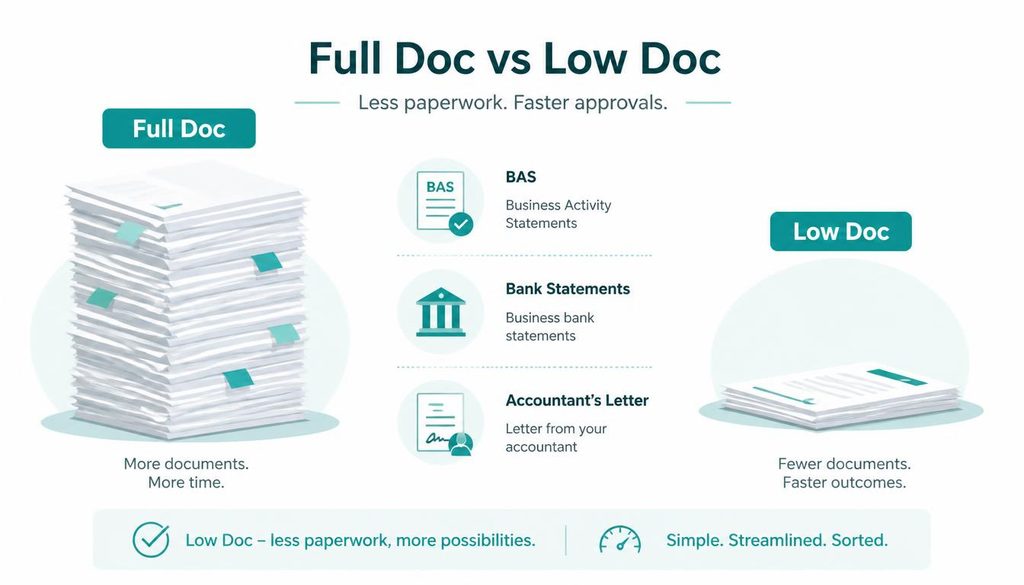
- Paperwork: Full doc requires complete financials, while low doc relies on BAS, bank statements and declarations.
- Speed: Assessments are often quicker because there is less to verify.
- Pricing: Expect higher rates and fees with low doc.
- Security: Lenders often lend a smaller percentage of an asset’s value.
- Best for: Full doc suits established, well-documented firms, while low doc suits owners with non-standard income.
How Does the Application Process Work?
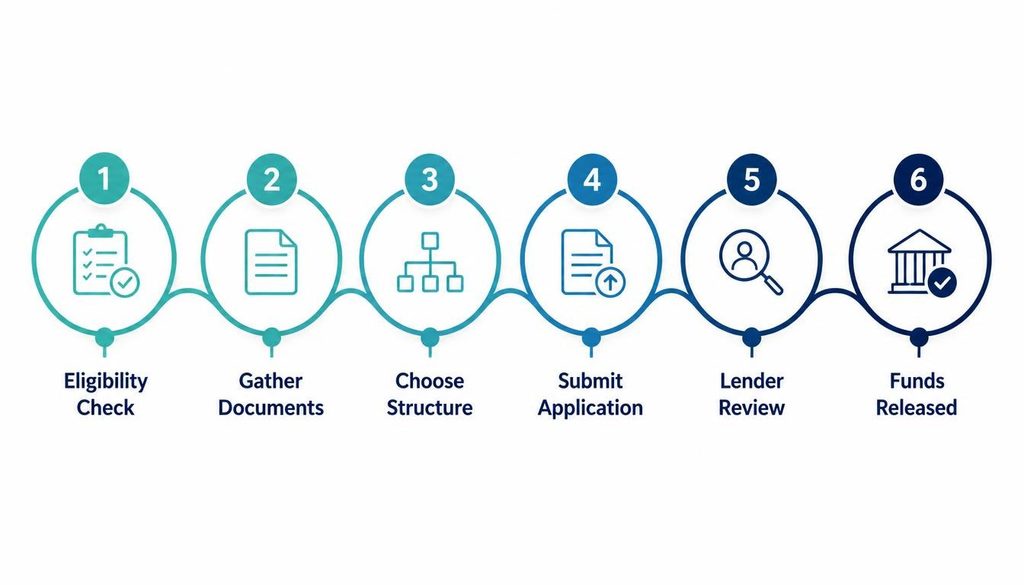
Most applications follow a similar path:
- Confirm your eligibility, including ABN age, GST registration and trading history.
- Gather your BAS, bank statements and accountant’s letter.
- Choose a structure, including secured or unsecured, term length and repayment style.
- Submit your application and income declaration.
- The lender reviews your credit file, cash flow and any security offered.
- Receive approval, sign the documents and access your funds.
When you apply for a low doc business loan, treat the declaration seriously. It is a formal statement of your income, and overstating it can lead to default, legal consequences and long-term damage to your credit profile. Honest numbers protect you as much as the lender.
Which Documents Should You Have Ready?
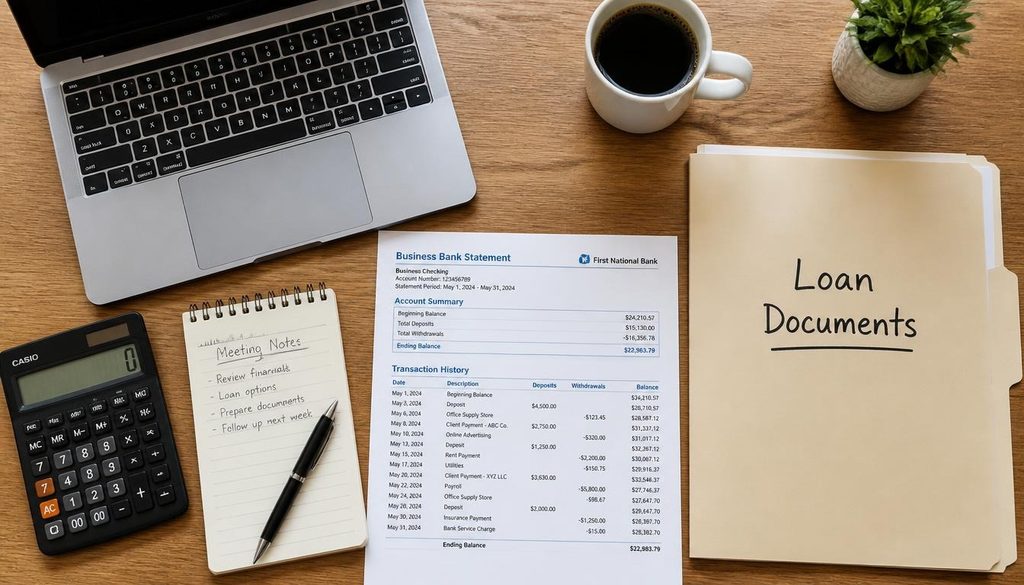
Being organised speeds everything up. Lenders commonly ask for:
- Your ABN and GST registration details
- Recent BAS lodgements
- Six to twelve months of business bank statements
- Photo ID for directors and guarantors
- A summary of existing debts and assets
- An accountant’s letter or signed income declaration
- Details of any security, such as a property title or equipment invoice
Having these items in a single folder before you speak to a lender shows professionalism and often shortens the assessment.
Who Are These Loans Best Suited To?
Plenty of capable businesses do not fit the traditional bank mould. Reduced-documentation lending often suits sole traders and contractors, newer businesses without two years of lodged returns, seasonal operators with lumpy income, and owners whose tax returns understate real cash flow because of deductions and depreciation.
For many owner-operators, low doc small business loans bridge the gap between what a tax return shows and what the business genuinely earns. Used well, low doc business finance can unlock growth that would otherwise stall, whether that means hiring staff, upgrading equipment or stocking up before a busy season.
A Quick Example

Imagine Sam, a Brisbane electrician who has run his own business for 18 months. His tax return shows modest profit after deductions and vehicle depreciation, yet his bank statements show steady monthly deposits. A full doc lender might hesitate. A low doc lender could assess his BAS and bank statements and approve funding for a second work van, likely at a higher rate and with a deposit. (This is a hypothetical example for illustration only.)
What Can You Use the Funds For?
Most lenders allow a wide range of commercial purposes, including:
- Working capital to smooth out cash flow
- Equipment, machinery and vehicles
- Inventory and bulk-buying opportunities
- Fit-outs, renovations and business expansion
- Refinancing existing business debts
Property is another popular use. Low doc commercial loans can help you buy a warehouse, office or shopfront when full financials are hard to produce. Expect a larger deposit and a more conservative valuation, though.
Secured vs Unsecured: Choosing the Right Structure
A secured loan uses an asset, such as property, vehicles or equipment, as collateral. Because the lender has something to fall back on, secured facilities tend to offer larger amounts, longer terms and lower rates.
A low doc unsecured business loan, on the other hand, does not require specific collateral, which appeals to owners who prefer not to put assets on the line. The trade-off is usually a smaller loan amount, a shorter term, a higher rate and often a personal guarantee from the directors.
When property is involved, low-doc commercial loans lean heavily on valuation. Lenders commonly cap borrowing at a lower percentage of the property’s value than they would for full doc applicants.
Can You Get Approved With a Poor Credit History?
Credit history matters, but it is not always a deal-breaker. Some non-bank lenders offer poor credit business loans to applicants with past defaults or late payments, provided the business can demonstrate reliable cash flow and, ideally, offer security.
Expect higher pricing and tighter conditions. Before applying, request your credit report from the major bureaus, correct any errors and avoid submitting multiple applications at once. Each enquiry can leave a mark on your file.
What Do Low Doc Loans Cost?
Because the lender carries more uncertainty, low-doc business loans generally come with higher interest rates than full doc alternatives. Pricing varies widely based on the lender, your credit profile, the security offered and market conditions. Always request a personalised quote rather than relying on advertised rates.
Look beyond the headline rate. Ask about establishment fees, monthly account fees, valuation and legal costs, and exit or early repayment charges. Request the full fee schedule in writing and compare the total cost of the loan over its term, not just the monthly repayment.
The Australian Market and What Queenslanders Should Know
A quick search for low doc business loan australia options reveals a mix of major banks, second-tier lenders and specialist non-bank financiers. Each has its own appetite for risk. Minimum trading history, maximum loan-to-value ratios and accepted industries differ from one lender to the next.
If you are comparing low doc business loans qld wide, look for providers who understand local conditions, from seasonal tourism swings on the Gold Coast to weather-affected trade in regional areas. A broker with local knowledge can help you match your circumstances to the right lender.
Advantages and Disadvantages at a Glance
Advantages
- Less paperwork and typically faster assessments
- Flexibility for irregular or hard-to-prove income
- Access for newer businesses and the self-employed
- Possible options even with a blemished credit file
Disadvantages
- Higher interest rates and fees
- Lower loan-to-value ratios and bigger deposits
- Shorter terms on some products
- Risk of over-borrowing if repayments are not stress-tested
Red Flags to Watch For
Fast funding does not mean you should skip due diligence. Be wary of any provider promising no doc business funding with guaranteed approval and zero checks, because responsible lenders always assess your ability to repay. Other warning signs include:
- Upfront fees before any assessment
- Pressure to sign quickly
- Vague or hidden fee structures
- Reluctance to provide terms in writing
Many business loans sit outside consumer credit protections, so read every term carefully. If a dispute arises, the Australian Financial Complaints Authority may be able to help eligible small businesses.
Tips to Strengthen Your Application
- Lodge your BAS on time and keep records tidy
- Separate business and personal bank accounts
- Show consistent deposits across recent months
- Pay down existing debts where possible
- Ask your accountant for a supporting letter
- Offer a larger deposit or additional security
- Define the loan’s purpose and how you will repay it
If your credit file is rocky, poor credit small business loans may still be possible when you can demonstrate strong cash flow and genuine security. You can also confirm your ABN details through ABN Lookup to make sure your registration is current before you apply.
Questions to Ask Before You Sign
Before committing, ask the lender what the total repayment amount will be, whether the rate is fixed or variable, what happens if your income dips, and whether you can make extra repayments without penalty. Clear answers now prevent expensive surprises later.
Alternatives Worth Considering
Low doc is not the only option. Consider equipment finance, invoice finance, a business line of credit, or a traditional full doc loan if your paperwork is in good shape. You can also explore support programs listed on business.gov.au and guidance from the Australian Small Business and Family Enterprise Ombudsman. Comparing at least three options helps you avoid paying more than necessary.
Final Thoughts
Low doc finance is a legitimate and practical tool for business owners whose paperwork does not tell the full story. The key is borrowing at a level your cash flow can genuinely support, understanding every fee and choosing a structure that matches your goals.

If you would like help comparing lenders and structures, White Alpaca Finance is a good place to start the conversation. Ready to explore your options? Speak with a finance specialist today and take the next step with clarity.
This article is general information only and not financial advice. Consider your circumstances and seek advice from a licensed professional before borrowing.
FAQs (People Also Ask)
1. Do I need an ABN to qualify for a low doc loan?
In most cases, yes. Lenders usually require an active ABN, and many prefer it to have been registered for at least six to twelve months. Some also ask for GST registration. Requirements differ between lenders, so confirm the criteria before you apply.
2. How long does approval usually take?
Because there is less paperwork to verify, approvals can be faster than full doc applications, often within days to a couple of weeks. Timing depends on the lender, the loan size, whether security is involved and how quickly you supply your documents.
3. Are low doc loans more expensive than standard business loans?
Generally, yes. Lenders take on extra uncertainty, so interest rates and fees are typically higher than for full doc loans. Compare the total cost over the loan term, including establishment and exit fees, rather than focusing on the rate alone.
4. Can I get a low doc loan with bad credit?
Possibly. Some non-bank lenders consider applicants with past defaults if the business shows consistent cash flow and offers security. Expect higher pricing and stricter conditions, and avoid applying to many lenders at once, as multiple enquiries can hurt your credit file.
5. How much can I borrow?
It depends on your income evidence, credit profile, the lender and any security. Lenders often lend a lower percentage of an asset’s value than for full doc loans, so a bigger deposit may be needed. A lender or broker can give you a realistic figure after assessing your situation.
6. What is the difference between low doc and no doc loans?
Low doc loans accept alternative evidence, such as BAS and bank statements, instead of full financials. No doc loans claim to need almost no evidence, but they are rare and often costly. Responsible lenders still check repayment ability, so treat “no checks” offers with caution.
7. Is it safe to give a self-declaration of income?
Yes, if it is accurate. A self-declaration is a formal statement, and overstating your income can lead to default, legal consequences and credit damage. Back it up with genuine BAS and bank statements, and ask your accountant to review your figures first.